 OpenWAM
OpenWAM: An Open, Modular Exploration Towards Systematic World–Action Model Pretraining
Yuran Wang1*‡, Siqiao Huang2*‡, Mingleyang Li3*, Chenhao Zhang3*, Jiaqi Liang3*, Weiyang Jin4, Yue Chen3, Xuemin Chi5, Donghao Zhou6, Qize Yu3, Yu-Kai Wang3, Yuhan Rui3, Shenzhe Yao2, Zhen Yuan4, Zhenhao Shen3, Kefei Zhu3, Zijie Zhu4, Ning Gao7, Xiaowei Chi3, Guanqi He2, Shanghang Zhang3, Hao Dong3, Lin Shao1†, Hang Zhao2†
- 1

- 2

- 3

- 4

- 5

- 6

- 7

* Equal contribution ‡ Project lead † Equal advising
Abstract
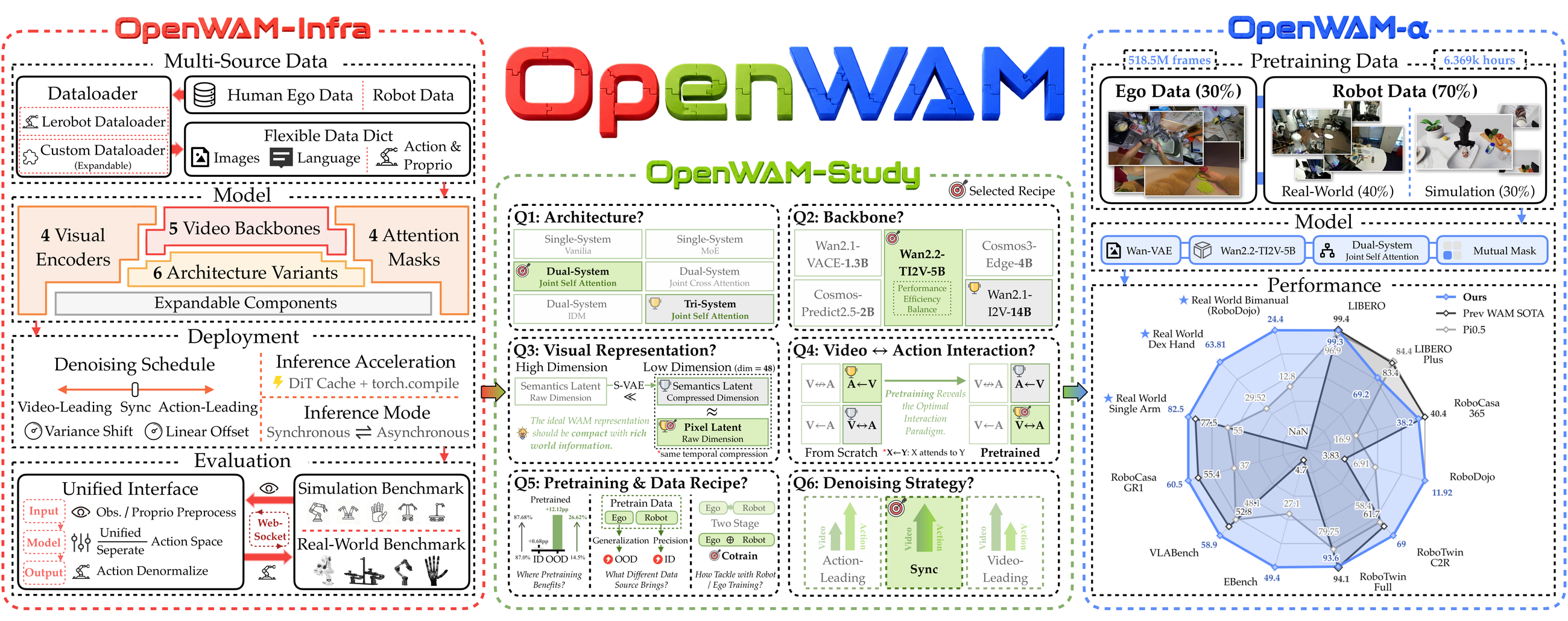
World–Action Models inherit world knowledge from video-generative priors, and channel it into executable control signals through embodied experience. Existing systems, however, are monolithic: the generative backbone, visual representation, architecture, information flow, inference procedure, and training data are tightly coupled, obscuring which design choices matter and why. We introduce OpenWAM, an open research stack that turns world–action pretraining into a controlled experimental program. OpenWAM-Infra factorizes the WAM design space into composable modules with unified training, inference, deployment, and evaluation. On this substrate, OpenWAM-Study examines three questions through controlled experiments: what to inherit, how world and action learning interact, and how their synergy scales; and distills three principles: upstream knowledge transfers through a sufficiently capable generative backbone and a compact, information-rich latent space; world–action synergy requires dedicated action capacity, explicit world-to-action information flow, and synchronized joint denoising; and embodied pretraining principally improves out-of-domain generalization, with one-stage co-training over egocentric and robot data integrating world coverage and action grounding. Composing these principles, we build OpenWAM-α, an open WAM pretrained on roughly 6,400 hours of egocentric human and robot data and evaluated across simulation and real-world benchmarks. Across the eight simulation benchmarks and the real-robot experiments, which together span embodiments from single-arm and bimanual manipulation to dexterous hands, OpenWAM-α delivers consistently excellent performance, sustaining its top-tier standing from simulation to the physical world. We release the full stack: infrastructure, evaluation protocols, pretrained models, and data recipes, to facilitate future research.
Video
One stack, three layers
Modularity makes world–action modeling a controlled experimental program rather than a set of coupled implementation choices.
OpenWAM-Infra
A modular infrastructure for world–action modeling
Factorizes the WAM design space into composable modules (dataloaders, encoders, backbones, architectures, attention masks) behind one trainer, one policy server, and one evaluation protocol spanning simulation and real robots.
- 4 visual encoders
- 5 video backbones
- 6 architecture variants
- 4 attention masks
OpenWAM-Study
Design principles for world–action synergy
Six controlled questions: architecture, backbone, visual representation, video↔action interaction, pretraining recipe, denoising strategy. Each is tested under the conditions the previous one established.
- Q1 Architecture
- Q2 Backbone
- Q3 Representation
- Q4 Interaction
- Q5 Data recipe
- Q6 Denoising
OpenWAM-α
From principles to a pretrained model
The recipe instantiated at scale on egocentric human and robot data through a unified action space, then evaluated across eight simulation benchmarks and three real-robot platforms.
- 518M frames (≈6,400 h)
- 80-D unified action space
- 8 simulation benchmarks
- 3 real-robot platforms
What the controlled study found
Three questions, asked in sequence. Each answer fixes the setup for the next.
- Finding 1What world knowledge should a WAM inherit?
A WAM inherits upstream world knowledge most effectively through a sufficiently capable generative backbone and a compact, information-rich visual representation space. Reconstructive encoders are not the only option; representation encoders with dimension compression are also performant.
- Finding 2How can we create synergy between world and action learning?
World–action synergy requires explicit world-to-action information flow during training, and synchronized joint denoising at inference.
- Finding 3How can this synergy be scaled across domains?
Embodied pretraining primarily expands OOD generalization. Robot trajectories preserve action grounding, egocentric video broadens transfer, and one-stage co-training integrates both effectively. At pretrained scale, mutual world–action visibility is consistently preferred.
The accumulated recipe
| Stage | Finding | Carried-forward default |
|---|---|---|
| Inherit | Capable video backbones and compact representation latents transfer the strongest upstream priors. | Wan2.2-TI2V-5B; compact latent |
| Interact | Dedicated action capacity and world-to-action visibility are necessary; synchronized denoising performs best. | Dual joint self-attention; synchronized denoising |
| Consolidate | Embodied pretraining primarily improves OOD generalization and consistently favors mutual visibility. | One-stage ego + robot co-training; mutual visibility |
OpenWAM-α
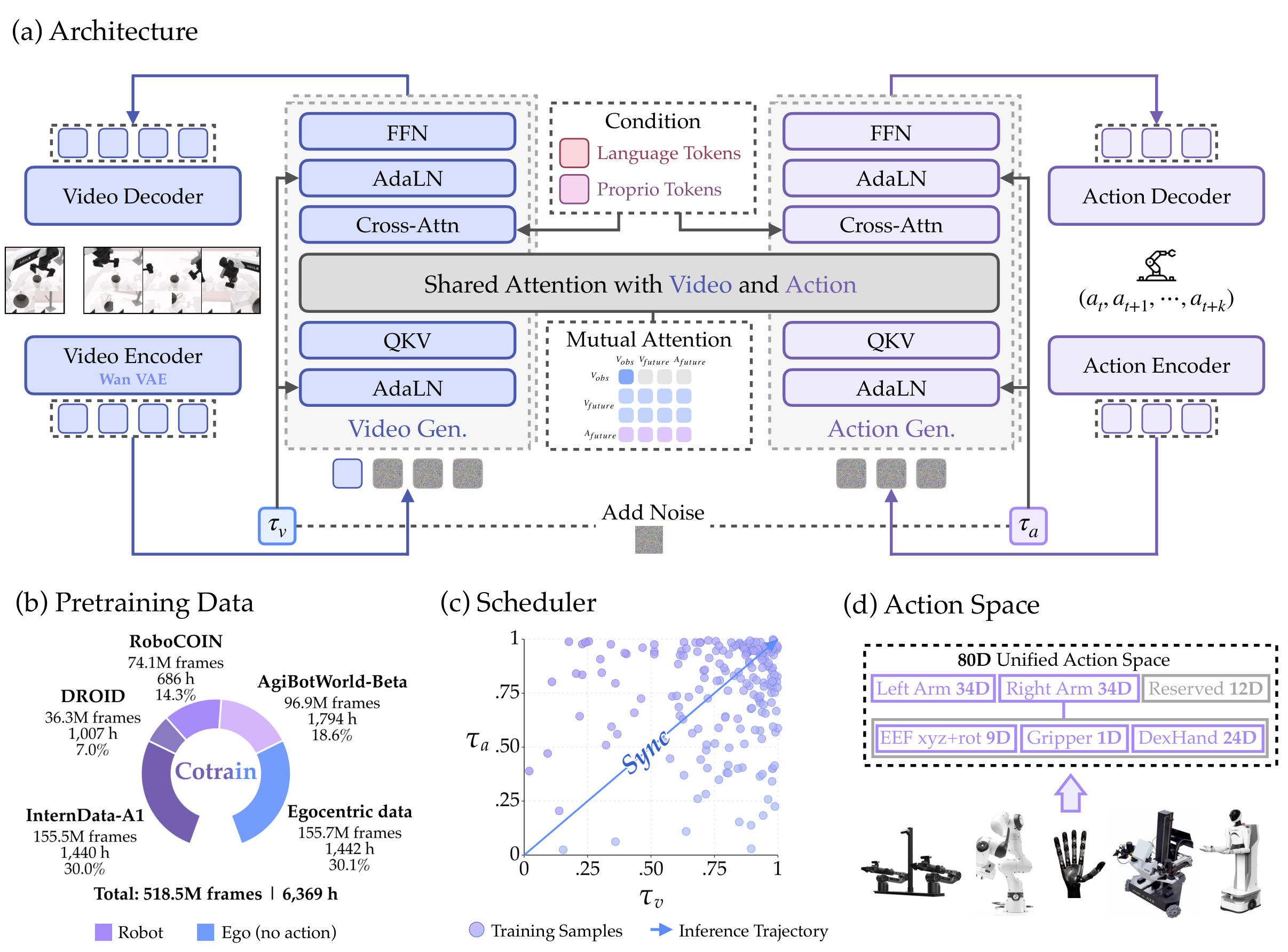
The recipe instantiated at scale: a dual-system model with mutual world–action visibility, co-trained in one stage on 518.5M frames (6,369 hours) of egocentric human and robot data through an 80-D unified action space.
 Open full size ↗
- Visual encoderQ3Wan2.2-VAEfrozen
Frozen. Encodes causally: the first frame alone, then groups of four. The first latent frame therefore stays a clean anchor of the present.
- World streamQ2Wan2.2-TI2V-5B
Pretrained DiT, width 3072, 3D RoPE over the (frame, height, width) grid. Denoises the future frames of the video window in latent space.
- Action streamQ1ActionDiT
Dedicated backbone, width 1024, 1D RoPE over the chunk index. One token per noised action step.
- CouplingQ1Joint self-attention
All 30 paired layers act as bridge layers, projecting both residual widths into a shared 24-head × 128-dim attention space.
- VisibilityQ4Mutual mask
Both streams read each other freely; clean first-frame rows attend to neither noised future frames nor actions.
- LanguageumT5frozen
Frozen. Maps the instruction into a 4096-dim context that both streams consume through their own cross-attention.
From simulation to the physical world
OpenWAM-α holds its standing across eight simulation benchmarks and three real-robot platforms, including a dexterous hand whose embodiment never appears in the mixture above.
Single-arm · Average success rate
- RoboDojo bimanual, real robot
- 37.6 / 24.4score / SR
- Simulation coverage
- 8benchmarks
- Pretraining data
- 6,400hours
- Open checkpoints
- 46models
vs 22.9 / 12.8 for π0.5, the next best
nine leaderboards across five embodiment categories
518M frames, 70% robot / 30% egocentric human
on the OpenWAM Hugging Face org
 99.3
99.3 96.6
96.6 97.6
97.6 98.5
98.5 99.2
99.2 99.293.6088.2591.8592.2493.8569.251.574.182.189.069.024.939.977.149.44.745.660.548.849.238.235.911.922.0358.9
Real-robot rollouts
The same policy across three real-robot experiments, from a single-arm gripper to bimanual platforms to a dexterous hand. Every task and camera view, scrollable left and right.
Single-arm gripper
Six tasks, each from the fixed scene camera.
Bimanual — RoboDojo
Successful runs across the three bimanual platforms, four each. OpenWAM-α averages 37.6 score / 24.4 SR over all eighteen tasks, against 22.9 / 12.8 for the next best.
Dexterous hand
An embodiment that never appears in the pretraining mixture: 21 hand DoF on top of a 6-DoF end-effector pose. In-distribution runs alongside each OOD variation.
Acknowledgements

We thank Wuji Technology for the compute resources that made this project possible, and for the Wuji dexterous hand on which the dexterous manipulation experiments were run.
Citation
@article{wang2026openwam,
  title   = {OpenWAM: An Open, Modular Exploration Towards Systematic World-Action Model Pretraining},
  author  = {Yuran Wang and Siqiao Huang and Mingleyang Li and Chenhao Zhang and Jiaqi Liang and Weiyang Jin and Yue Chen and Xuemin Chi and Donghao Zhou and Qize Yu and Yu-Kai Wang and Yuhan Rui and Shenzhe Yao and Zhen Yuan and Zhenhao Shen and Kefei Zhu and Zijie Zhu and Ning Gao and Xiaowei Chi and Guanqi He and Shanghang Zhang and Hao Dong and Lin Shao and Hang Zhao},
  year    = {2026},
  journal = {arXiv preprint arXiv: 2609.07398}
}